HVAC SEO is the work that helps your company show up on Google when someone nearby needs heating or cooling help. It covers your Google Business Profile, your reviews, your service pages, and your website basics.
Done right, it brings you calls you do not pay for one by one. Done wrong, you stay invisible while competitors take the jobs. This guide explains the whole thing in plain words: what matters most, what it costs, how long it takes, and what to fix first.
The short version:
- HVAC SEO helps your company show up in the free Google results when someone searches for heating or cooling help near you.
- The biggest wins come from your Google Business Profile, steady reviews, and one page on your site for each service you sell.
- Google says results usually take from four months to a year, so judge progress in quarters, not weeks.
- Start with the free steps in the checklist below. Then decide what to do yourself and what to hand to an expert.
What this guide covers:
- What is HVAC SEO?
- Why HVAC SEO is different from other SEO
- What each part of the Google search page does
- The six things that move the needle
- The HVAC SEO work calendar
- What does HVAC SEO cost?
- What we see go wrong in HVAC SEO audits
- Should you do it yourself or hire help?
- How to know it is working
- HVAC SEO questions, answered
What is HVAC SEO?
HVAC SEO means getting your heating and cooling company to show up in the free results on Google. When a homeowner searches for AC repair, furnace installation, or a tune up, your business can appear in the map results.
It can also appear in the links below them. It is how you win calls without paying for every click.
SEO stands for search engine optimization. That is a long name for simple work: making your website and listings clear so Google can understand them. For HVAC contractors it comes down to four parts:
- Your Google Business Profile. The listing that can put your business on Google Maps.
- Your service pages. One page for each service you sell, like AC repair or furnace installation.
- Your reviews. What past customers say about you on Google.
- Your website basics. A fast site that works well on phones.
Each part is simple on its own. Together they decide whether your phone rings. The rest of this guide walks through them one by one.
Why HVAC SEO is different from other SEO
HVAC search has its own shape. Understanding it saves you from spending money on the wrong things.
Most searches are urgent. A homeowner with no AC in July is not browsing. They call one of the first companies they see.
Your phone number must be easy to find and easy to tap.
Demand swings with the seasons. Cooling searches climb in spring and summer. Heating searches climb in fall and winter.
Smart contractors start their SEO work months before the busy season, not during it.
Your market is local. You serve a defined area, not the whole country. Ranking in another state does nothing for you.
Every part of your SEO should point at the towns you actually serve.
Trust decides the call. You work inside people’s homes. Reviews, photos of real jobs, and a complete profile matter more here than in most trades.
What each part of the Google search page does
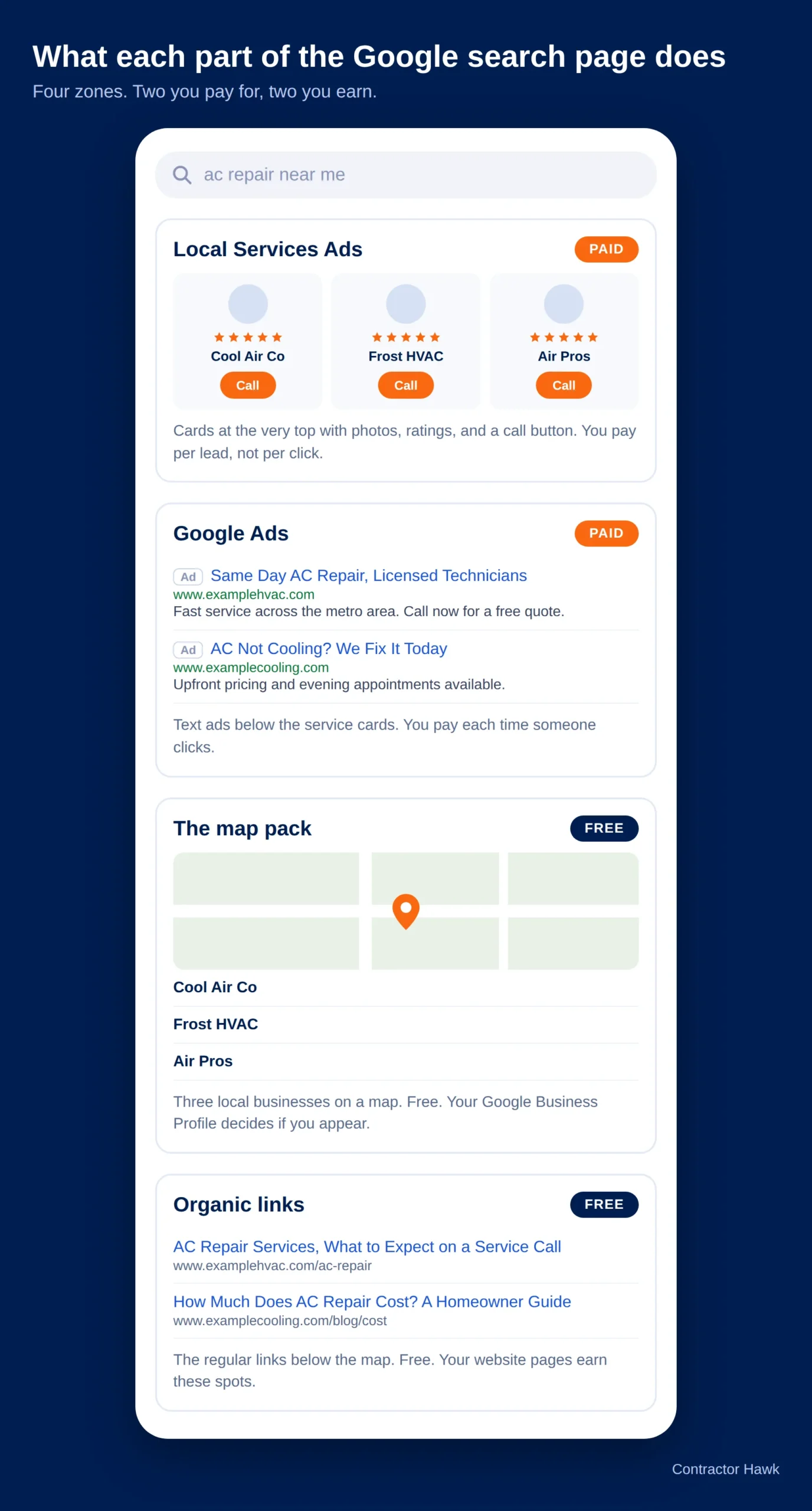
Search “AC repair near me” on your phone. You will see four kinds of results stacked on top of each other. Each one works differently.
- Local Services Ads. Cards at the very top with photos, ratings, and a call button. You pay per lead, not per click. Google shows a Google Verified badge on these ads. Google explains the Verified badge here.
- Google Ads. Text ads below them. You pay each time someone clicks.
- The map pack. Three local businesses on a map. These results are free. Your Google Business Profile decides whether you appear here.
- Organic results. The regular links below the map. Also free. Your website pages earn these spots.
Paid results bring calls fast and stop the day you stop paying. Free results take months to earn but keep bringing calls after that. Most healthy HVAC companies use both.
The six things that move the needle
You do not need to do everything at once. These six, in this order, bring most of the results.
1. Your Google Business Profile
This is the single most important piece. It feeds the map pack, those three map results at the top of a local search.
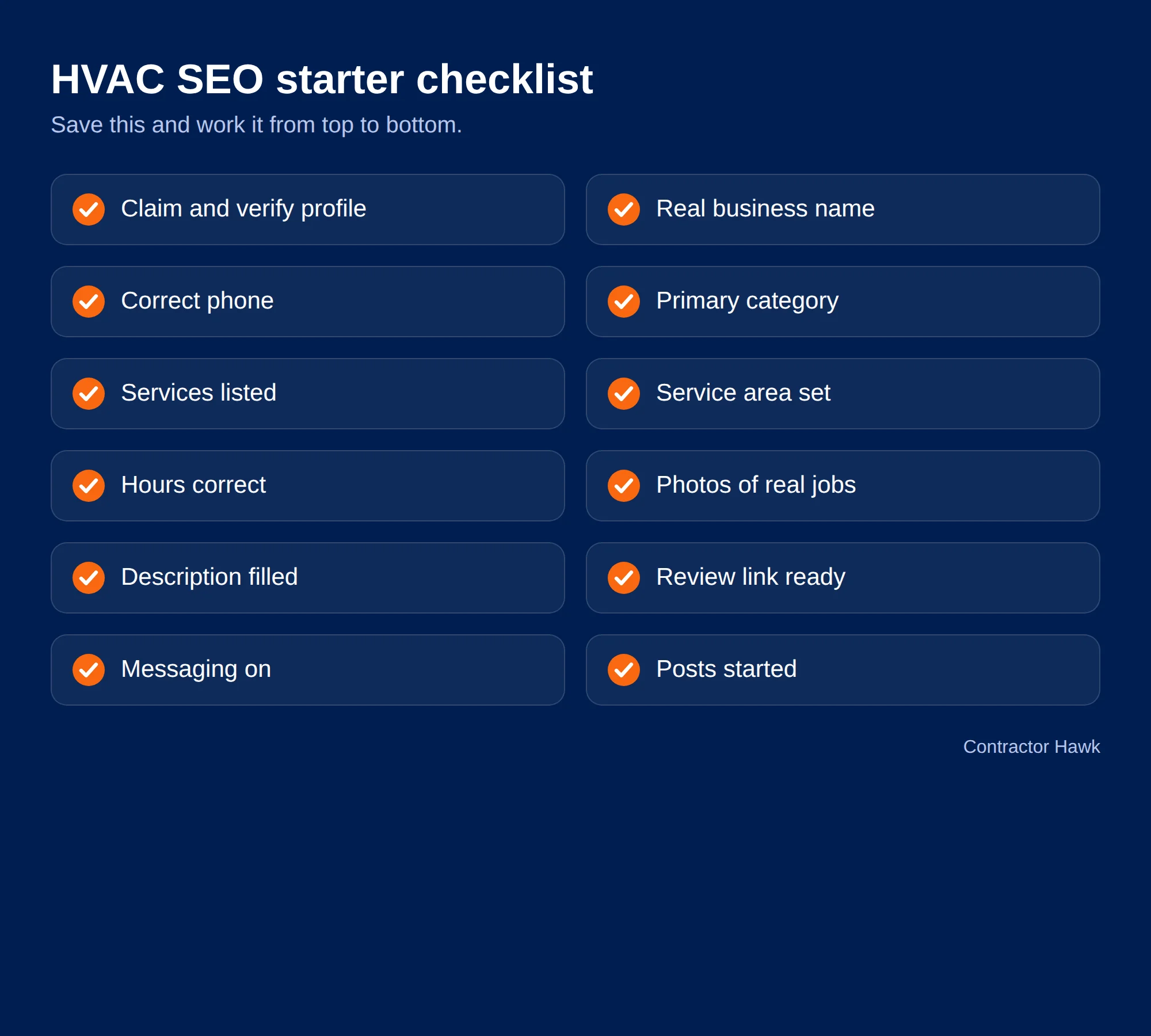
Claim your profile and verify it. Then fill in every field. Use your real business name and phone number.
Set your primary category, list your services, define your service area, add your hours, and upload photos of real jobs.
Google lets you add or claim your profile at no charge. See Google’s own setup steps. For the full walkthrough, read our guide to setting up and fixing your Google Business Profile.
2. Reviews
Reviews decide who gets the call when two companies look equal. A steady flow of recent reviews also feeds the map pack.
Ask every happy customer for a Google review. Send a short text with a direct link right after the job. Respond to every review within a day or two, good or bad.

3. One page per service
Give each service its own page. A page about AC repair should be about AC repair, nothing else.
Each page should explain the service in plain words, name the towns you serve, and make it easy to call. Learn what homeowners actually type into Google so each page matches a real search.
Serve more than one town? Give each main town its own page too. Read our guide to service area pages to see when to build them and what to put on them.
4. Local listings that match
Your business name, address, and phone number must match exactly everywhere Google looks. Yelp, Angi, the BBB, and trade directories all count.
One old phone number on one directory can confuse Google. Our guide to HVAC citations and directories shows which ones actually matter.
5. Website basics
Your site must load fast on a phone. Your phone number should sit at the top of every page. A visitor should be able to call or request a quote in seconds.
Nothing fancy is needed. See HVAC website SEO basics for the short list that covers most of it.
6. Helpful pages that answer questions
Write short pages that answer the questions you hear on every call. Why is my AC freezing up? How often should I change my filter?
What size unit do I need? These pages build trust and pull in searches your service pages miss.
These pages build trust and pull in searches your service pages miss. Each one should link to the service page it relates to. For the bigger picture, read our guide to local SEO for HVAC companies.
The HVAC SEO work calendar
SEO is a sequence, not a single job. The table below shows what real work looks like across a year. If you hire help, this is what you should see them doing each month.
| Month | What gets done | Who does it |
|---|---|---|
| 1 | Audit: claim your profile, check listings, test site speed on a phone | You or an expert |
| 2 | Fix the basics: correct name, address, and phone everywhere; complete your profile | You or an expert |
| 3 to 4 | Build one page per service; add town pages for your main service areas | Expert, with your input |
| 5 to 6 | Start the review system: text every customer after each job; answer all reviews | Your office staff |
| 7 to 9 | Add helpful articles; clean up old directory listings; keep reviews coming | Expert plus your staff |
| 10 to 12 | Check which pages bring calls; improve the weak ones; keep publishing | Expert, with your numbers |
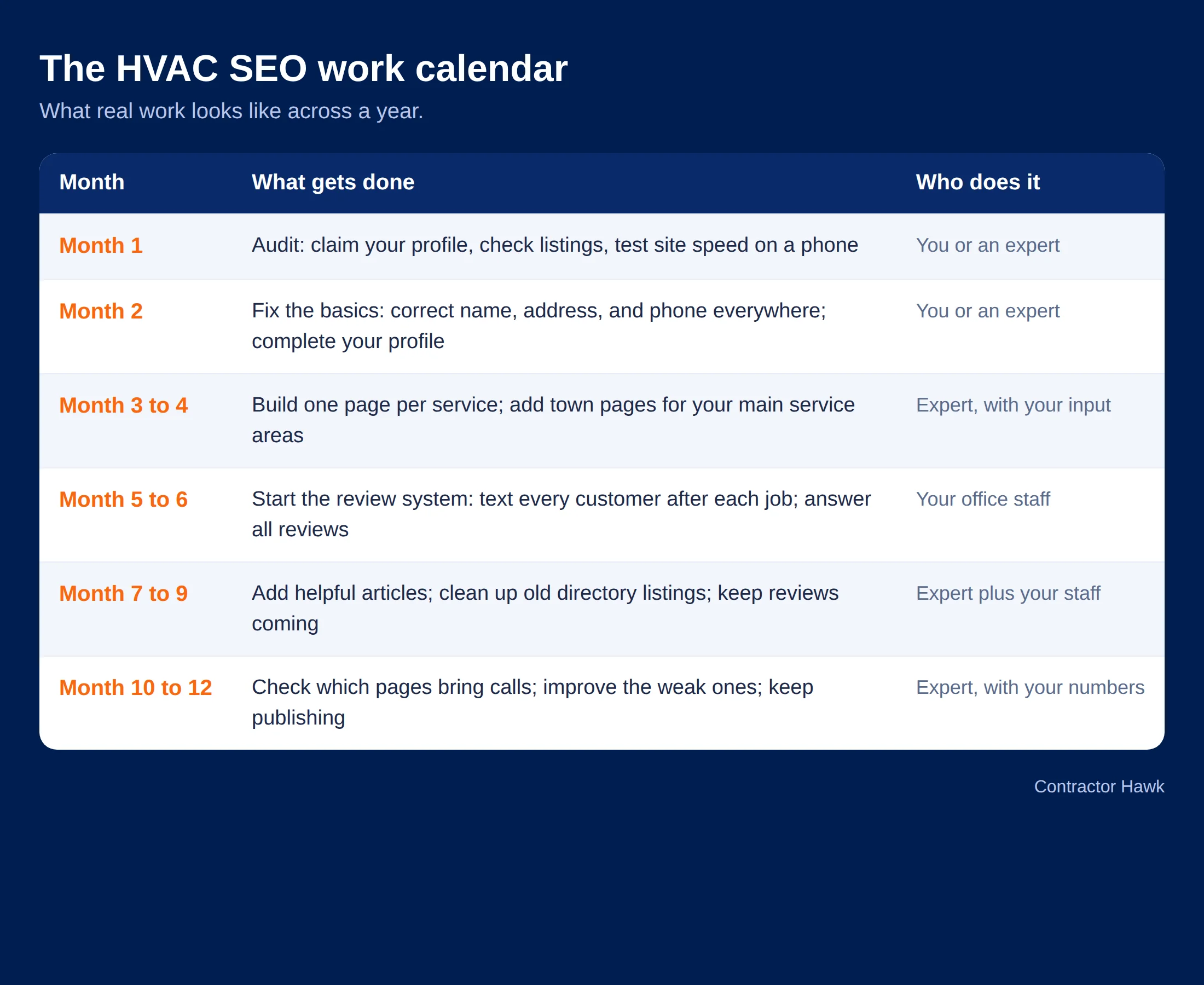
Notice what is missing: no tricks, no shortcuts. Google says it takes time to see results, often from four months to a year. Read our post on how long local SEO takes for the honest version of this timeline.
What does HVAC SEO cost?
Some of the most useful SEO work costs nothing but your time. The table shows the split.
| The work | Cost | What it takes |
|---|---|---|
| Google Business Profile setup | Free | One careful afternoon |
| Asking for reviews | Free | A text after each job |
| Claiming directory listings | Mostly free | A few hours of cleanup |
| Writing service pages | Your time | A few evenings, or a writer |
| Hiring an agency or freelancer | Monthly fee, varies widely | Ongoing; ask what is included each month |
| Tools like call tracking | Monthly fee, varies widely | Worth it once calls matter |

We do not list a price for paid help because honest pricing depends on your market, your site, and your locations. When you compare quotes, ask what the company will do in month one, month three, and month six. Vague answers are a red flag.
Want to know what that fee should buy? Read what an agency does for HVAC companies day to day, and what an HVAC SEO agency does month by month.
What we see go wrong in HVAC SEO audits
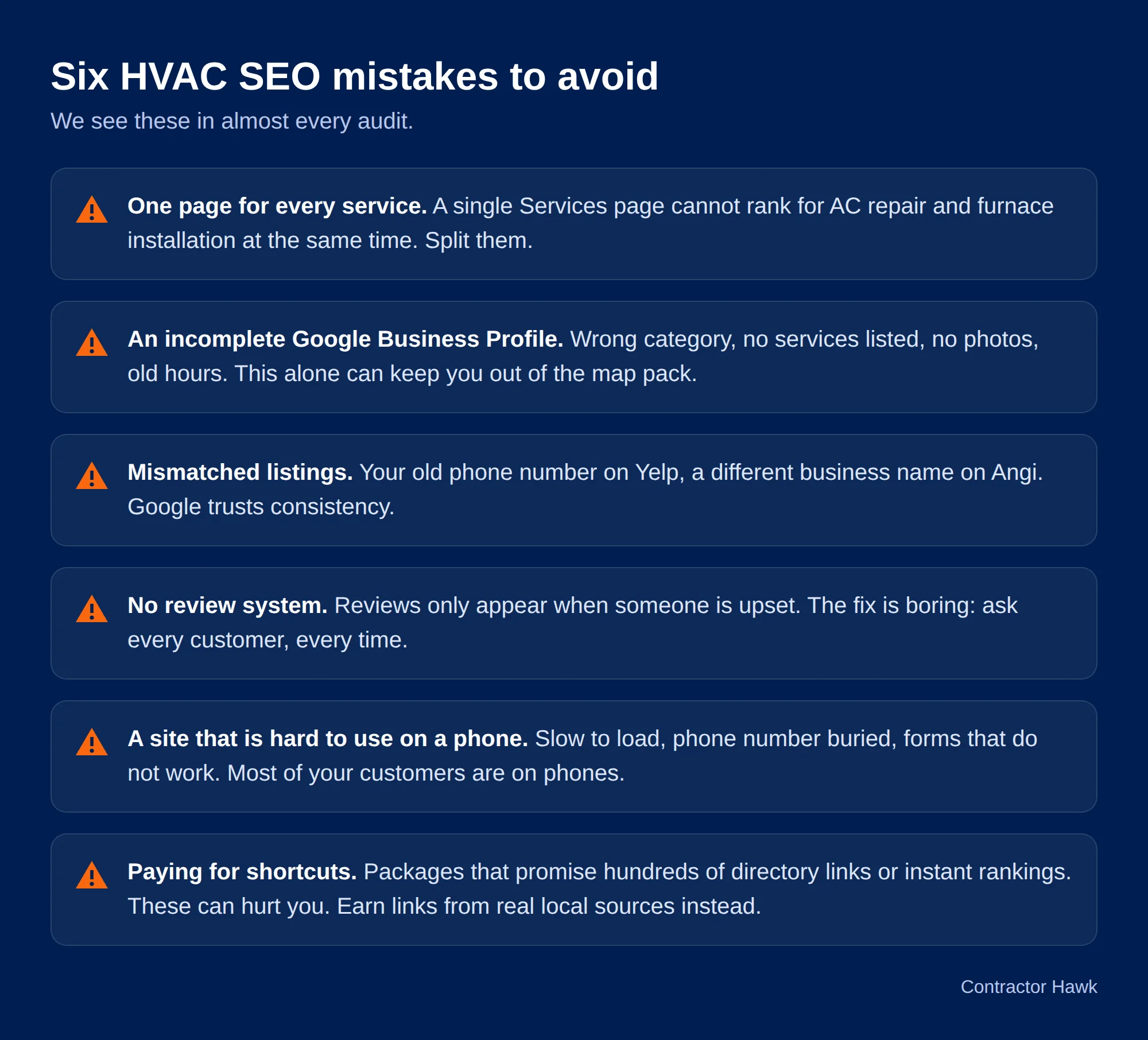
We look at a lot of contractor websites. The same mistakes show up again and again. Each one costs calls.
- One page for every service. A single “Services” page cannot rank for AC repair and furnace installation at the same time. Split them.
- An incomplete Google Business Profile. Wrong category, no services listed, no photos, old hours. This alone can keep you out of the map pack.
- Mismatched listings. Your old phone number on Yelp, a different business name on Angi. Google trusts consistency.
- No review system. Reviews only appear when someone is upset. The fix is boring: ask every customer, every time.
- A site that is hard to use on a phone. Slow to load, phone number buried, forms that do not work. Most of your customers are on phones.
- Paying for shortcuts. Packages that promise hundreds of directory links or instant rankings. These can hurt you. Earn links from real local sources instead.
Want a second pair of eyes on your own setup? Our free audit shows what is costing you calls.
Should you do it yourself or hire help?
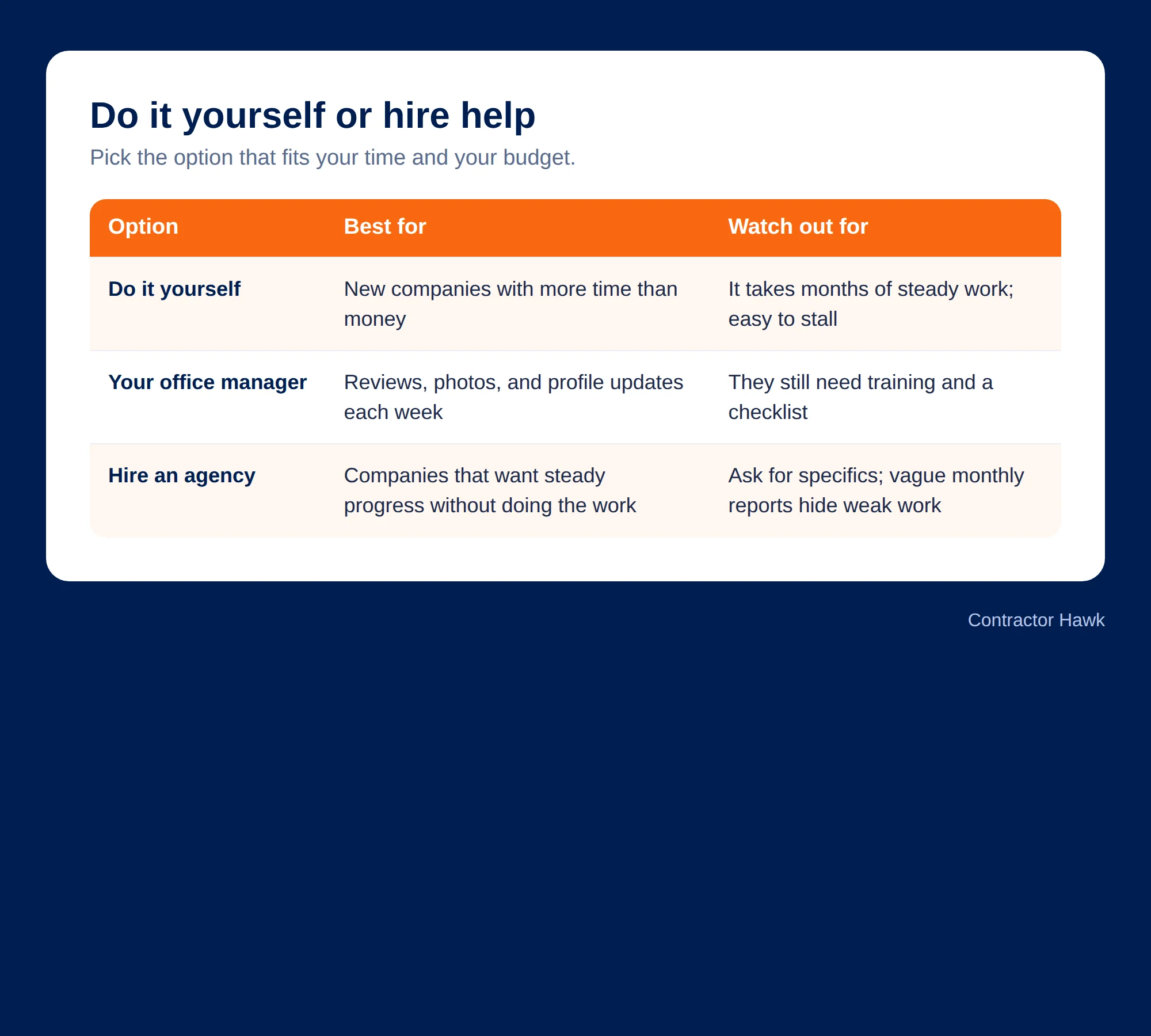
Google says a small local business can do much of this work itself. That is true for the basics like your profile and reviews. The real question is what your time is worth.
| Option | Best for | Watch out for |
|---|---|---|
| Do it yourself | New companies with more time than money | It takes months of steady work; easy to stall |
| Your office manager | Reviews, photos, and profile updates each week | They still need training and a checklist |
| Hire an agency | Companies that want steady progress without doing the work | Ask for specifics; vague monthly reports hide weak work |
Before you sign anything, read Google’s own advice on hiring an SEO. Two points stand out.
No one can guarantee you the number one spot. And you are responsible for what any company you hire does to your site.
If you want outside help, learn what to expect from an HVAC SEO agency. And see how a marketing partner for HVAC companies can fit your growth plan.
How to know it is working
Rankings bounce up and down every week. Calls do not lie. Track the three numbers that matter:
- Calls from Google. Use a tracked number on your profile and site so you know which calls came from search.
- Quote requests. Count form fills and booking requests, not just visitors.
- Booked jobs. Ask every new customer how they found you. Write it down.
If an agency reports to you, ask for booked calls from organic search. Do not accept rankings or traffic alone. And give it time: judge in quarters, not weeks.
HVAC SEO questions, answered
How long does HVAC SEO take to see results?
Plan on months, not days. Google says it usually takes from four months to a year to see the benefits of SEO changes.
Map results often move first, inside the first few months. Competitive searches like AC repair in a big city can take the better part of a year. Judge progress in quarters.
How much does HVAC SEO cost?
The basics are free: your Google Business Profile costs nothing to claim, and asking for reviews costs nothing but a text message. Paid help varies widely with your market and your site. Ask any company what they will do in month one, three, and six before you compare prices.
Can I do HVAC SEO myself?
Yes, for the basics. Google says a small local business can do much of the work itself.
You can claim your profile, fix your listings, ask for reviews, and write simple service pages. Hire help when the work needs skills you do not have, or when your time is better spent running jobs.
Is HVAC SEO better than Google Ads?
They do different jobs. Ads bring calls within days and stop when you stop paying.
SEO takes months but keeps bringing calls without a per click cost. Most contractors run ads for fast calls while building SEO in the background, then spend less on ads as organic calls grow.
How important are Google reviews for HVAC SEO?
Very. Reviews feed the map pack and decide who gets the call. Keep a steady flow of new reviews, answer every one, and never buy fake ones.
One honest review after each job beats a burst of old ones. Make asking part of your closeout routine.
What is the difference between local SEO and regular SEO for HVAC?
Local SEO targets customers near you: the map pack, your Google Business Profile, and town pages. Regular SEO targets broader searches without a location.
For HVAC, local SEO brings almost all the calls. That is why this guide spends most of its time on your profile, reviews, and service area.
What to do next
Start with the free work: claim your profile, fix your listings, and ask every customer for a review this week. HVAC SEO rewards the contractor who does the boring basics every month, not the one who chases tricks.
Want a second pair of eyes? Get our free audit and we will show you what is costing you calls.
Our promise: “10 new customers in 60 days, or your third month is free.” See the terms.