When the AC dies in July, the homeowner calls whoever shows up first on Google. HVAC Google Ads put your name in that spot, but the clicks are some of the most expensive in home services. This guide shows what HVAC companies actually pay per lead in 2026.
You will learn how to set up campaigns that turn clicks into booked jobs, and which mistakes burn money. You also get real benchmark numbers, a setup checklist, and a simple way to tell if the math works for your shop.
Quick answer:
- What to do: Run one campaign for your company name, one for emergency repair, and one for install jobs. Track phone calls as conversions, send each ad to its own service page, and block bad searches every week.
- Is it worth it: Leads run from $104 to $335 in 2026 benchmarks. If you book one lead in three and your average job covers the cost several times over, Google Ads pays. Emergency repair keywords usually pay back first.
In this guide:
- What Do HVAC Google Ads Cost?
- Is Google Ads Worth It for Your HVAC Company?
- How to Set Up HVAC Google Ads Campaigns
- What Makes Your Cost Per Lead Go Up or Down
- Common Mistakes HVAC Contractors Make With Google Ads
- Should You Run Google Ads, Local Services Ads, or Both?
- Frequently Asked Questions
What Do HVAC Google Ads Cost?
Three 2026 benchmarks put HVAC Google Ads leads from $104 to $335 per lead. The 99calls study of managed campaigns found a median from $190 to $335.
SearchLight Digital tracked $14.9M in spend and found a blended $104. Your cost depends on your market, your services, and how your account is built.
Here is what each public benchmark actually measured:
| Source | What was measured | Typical cost per lead |
|---|---|---|
| 99calls, first half of 2026 | Median across managed HVAC campaigns | from $190 to $335 |
| SearchLight Digital, Jan 2026 | Blended across 816 contractors and $14.9M in ad spend | $104 |
| LocaliQ, 2025 benchmark | AC install and repair, over 3,200 campaigns | $127.74 |
The numbers differ because the studies count different things. 99calls reports the median for managed campaigns, which skews toward competitive markets.
SearchLight blends every campaign type together, including cheap branded searches. Read the breakdown before you pick a number to plan with.
The SearchLight data gets more useful when you split it by campaign type:
| Campaign type | Cost per lead | Share that books a job |
|---|---|---|
| Branded search (your company name) | $34 | 55.3% |
| Non branded search (new customers) | $149 | 37.6% |
| Performance Max | $72 | 32.2% |
Branded searches are cheap because the homeowner already knows you. Non branded searches cost about four times more, but they are the only way to reach people who never heard of you. That is the trade at the heart of every HVAC account.
99calls also broke costs down by service. AC repair leads averaged $289, while AC install and replacement leads averaged $353.
Repair searches convert better because the need is urgent. Install searches convert less often because homeowners shop around.
Their top 10 percent of campaigns pulled leads from $159 to $273. That shows structure matters more than market.
One more honest note from the data. In the most competitive months, the 99calls study saw lead costs spike past $1,000 in some markets.
That is the exception, not the rule. But it is why summer budgets need a cushion.
Is Google Ads Worth It for Your HVAC Company?
Do not judge Google Ads by cost per lead alone. Judge it by cost per booked job. A $149 lead that books is cheaper than a $60 lead that never answers.
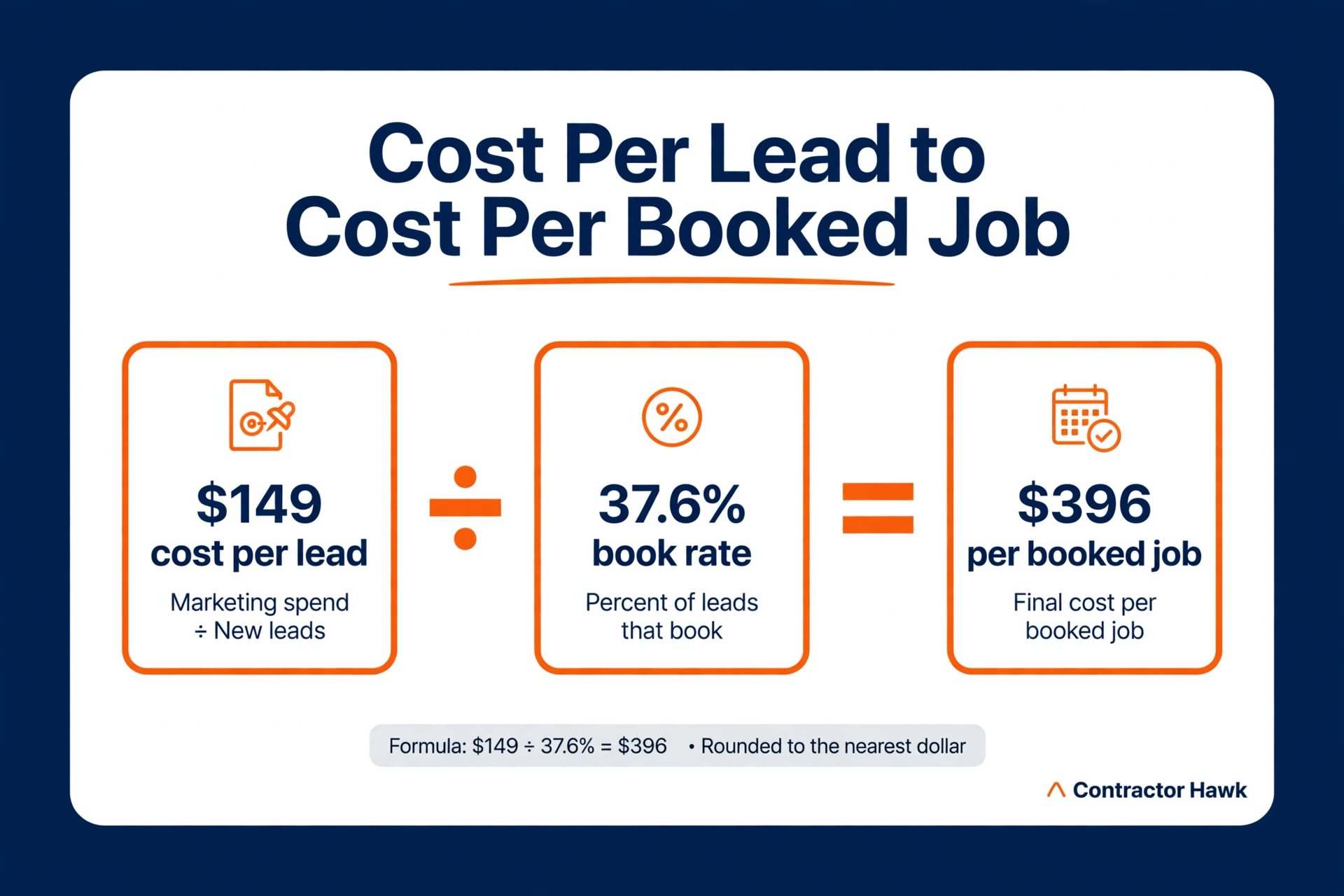
Here is the math, using the SearchLight benchmark numbers. Non branded leads cost $149, and 37.6 percent book a job. Divide $149 by 0.376 and you get about $396 per booked job.
Now compare that number to what a job is worth to you. If your average ticket leaves room after $396, the channel works. If your office books better than 37.6 percent, your cost per job drops further.
Run this check before you raise your budget:
- Do you answer every call live, or call back in minutes? A lead you never reach is the most expensive kind.
- Do you know your close rate on inbound leads? Guessing here makes every other number meaningless.
- Is your average job worth several times your cost per booked job? Repair tickets and installs clear this bar more easily than tune ups.
- Can you fund 60 to 90 days of testing? The first month buys data. The learning pays off after that.
If you answered yes down the list, Google Ads is worth testing. For the full money picture, see how to set your HVAC marketing budget before you pick a monthly number.
How to Set Up HVAC Google Ads Campaigns
You can run this yourself, or hand it to a marketing partner for HVAC companies. Either way, the structure below is what separates accounts that book jobs from accounts that burn cash.
Track calls before you spend a dollar
Set up conversion tracking on day one, and count phone calls as conversions. Most HVAC leads call.
If you only track form fills, you are flying blind. Google walks through the setup in its guide to tracking conversions, including calls from ads.
Give each intent its own campaign
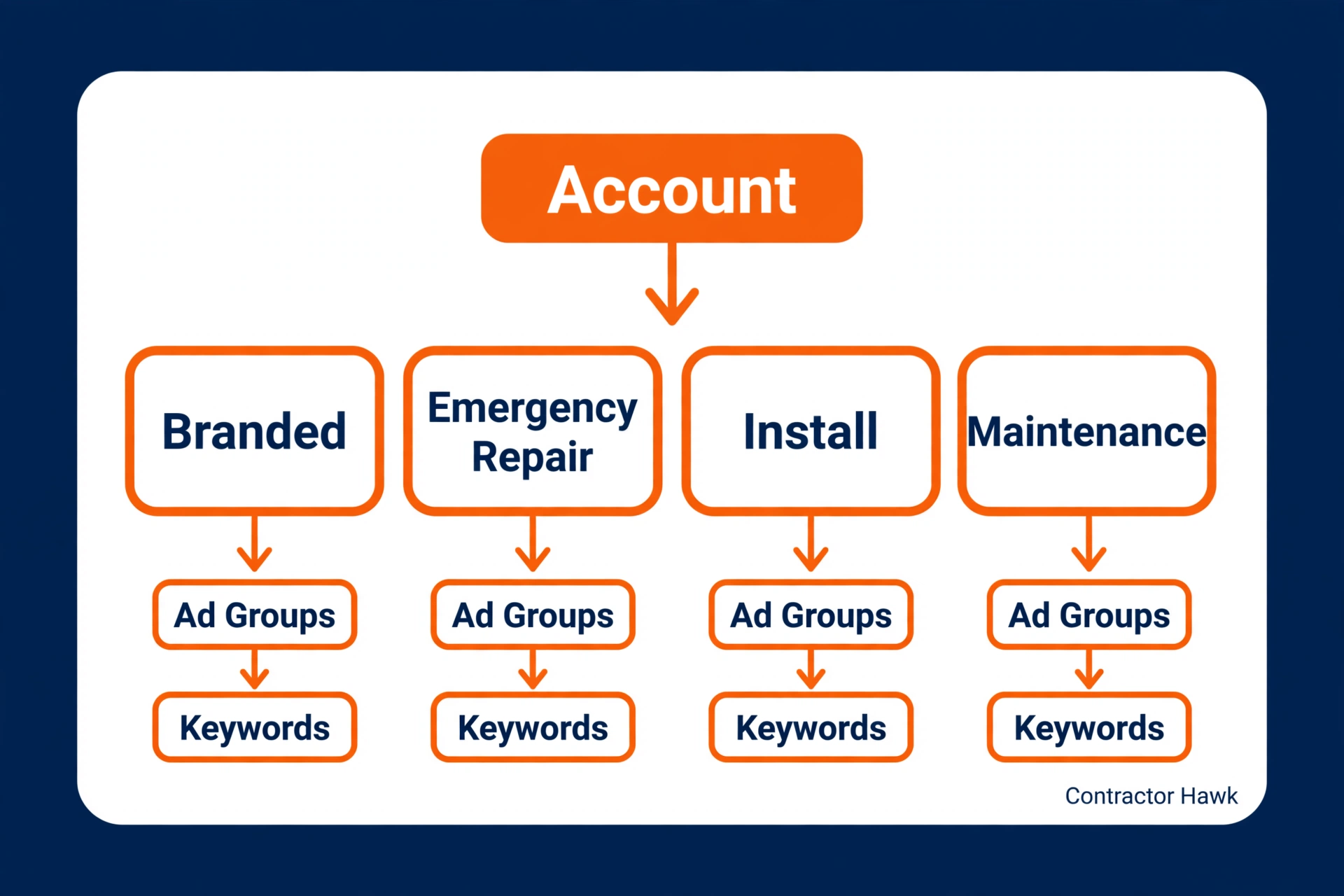
Do not put everything in one campaign. Build four: your company name, emergency repair, install and replacement, and maintenance.
Give each its own budget. That way a hot July week for AC repair never steals money from your install campaign.
Give a new account room to learn. Google needs a steady flow of conversions to bid well.
That means a daily budget you can hold for weeks, not one you pause and restart. Most wasted spend comes from accounts that get turned on and off like a light switch.
Pick keywords that show buying intent
Bid on what a homeowner types when the AC is dead: AC repair near me, emergency furnace repair, AC replacement cost.
Start with phrase and exact match so you control which searches trigger your ads. Google explains the keyword match types here.
Broad match has its place, but only after your negatives are solid.
Block the junk from day one
Add negative keywords before launch: jobs, hiring, DIY, school, free, cheap parts, wholesale. Then open the search terms report every week and keep adding.
Every irrelevant click costs real money, and junk searches never stop on their own. Review what your keywords actually matched each week.
Move winners to exact match and demote the rest. Match types are not set and forget.
Write ads that earn the call
Say what the homeowner gets: same day service, upfront pricing, licensed techs. Put your phone number where thumbs can tap it.
Skip clever wordplay. A homeowner with no heat at midnight wants a phone number, not a slogan.
Send clicks to pages that book jobs
Each ad group gets its own page. One service, one phone number, one big call button, and a page that loads fast on a phone.
Never send paid clicks to your homepage. If this sounds like a lot of weekly upkeep, see what an HVAC PPC agency handles each month.
What Makes Your Cost Per Lead Go Up or Down
You control most of these. Two of them you do not, so plan around them.
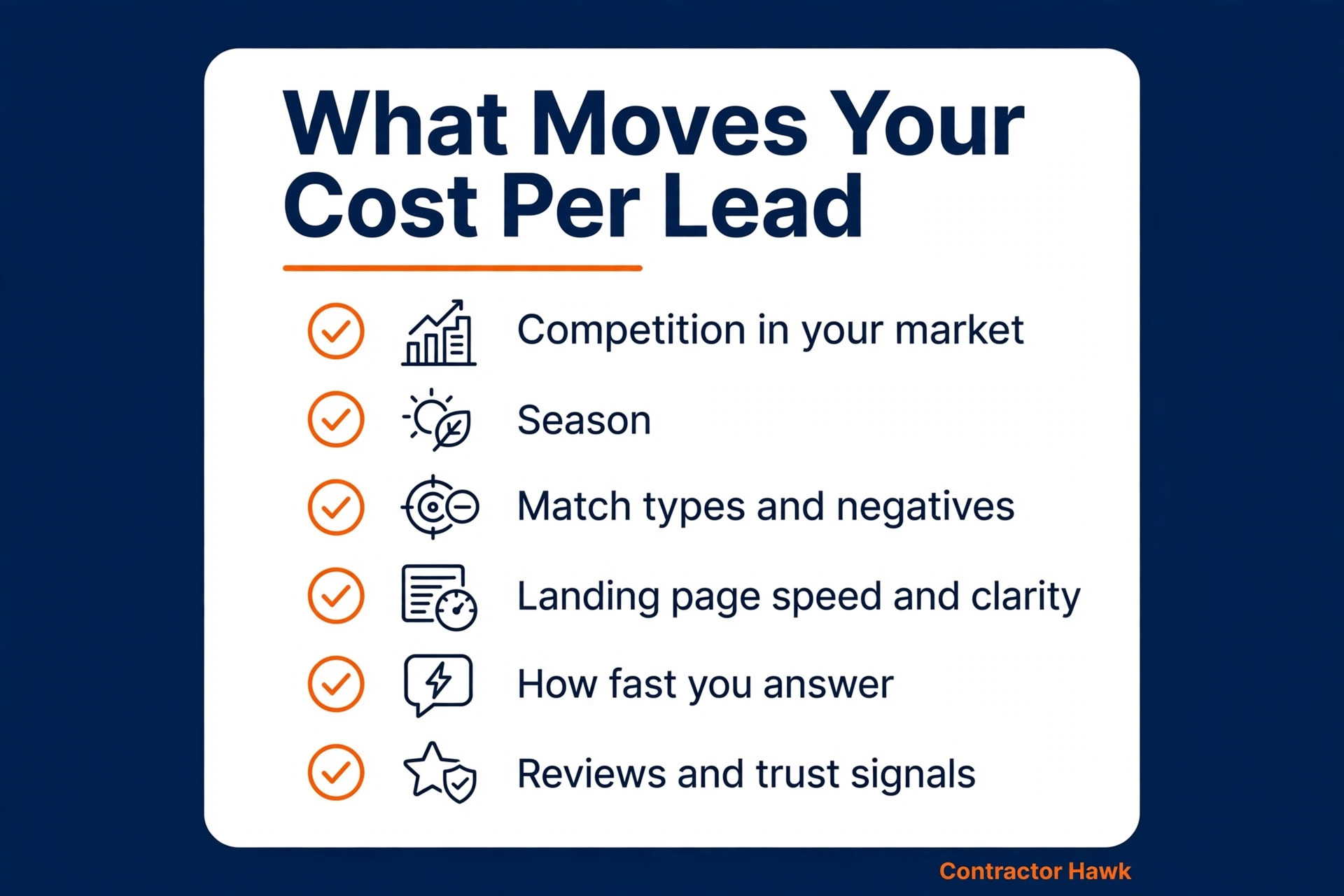
- Competition in your market. Ten bidders for five clicks means high prices. Fewer bidders means cheaper leads.
- Season. July and January cost more than April and October. Demand sets the auction.
- Match types and negatives. Broad keywords with no negative list invite junk clicks. Tight match types with weekly cleanup keep costs down.
- Landing page speed and clarity. A slow page turns paid clicks into bounces. A clear page with one call button turns them into calls.
- How fast you answer. The shop that picks up books the job. Speed is free leverage.
- Reviews and trust signals. People click the ad, then call the company they trust. Strong reviews lift conversion without touching bids.
Your close rate is a hidden cost lever. Two shops can pay the same $149 per lead.
The shop that books half its leads pays about $298 per job. The shop that books one in four pays about $596.
Same ads, double the cost. That is why the phone process matters as much as the campaign.
Common Mistakes HVAC Contractors Make With Google Ads
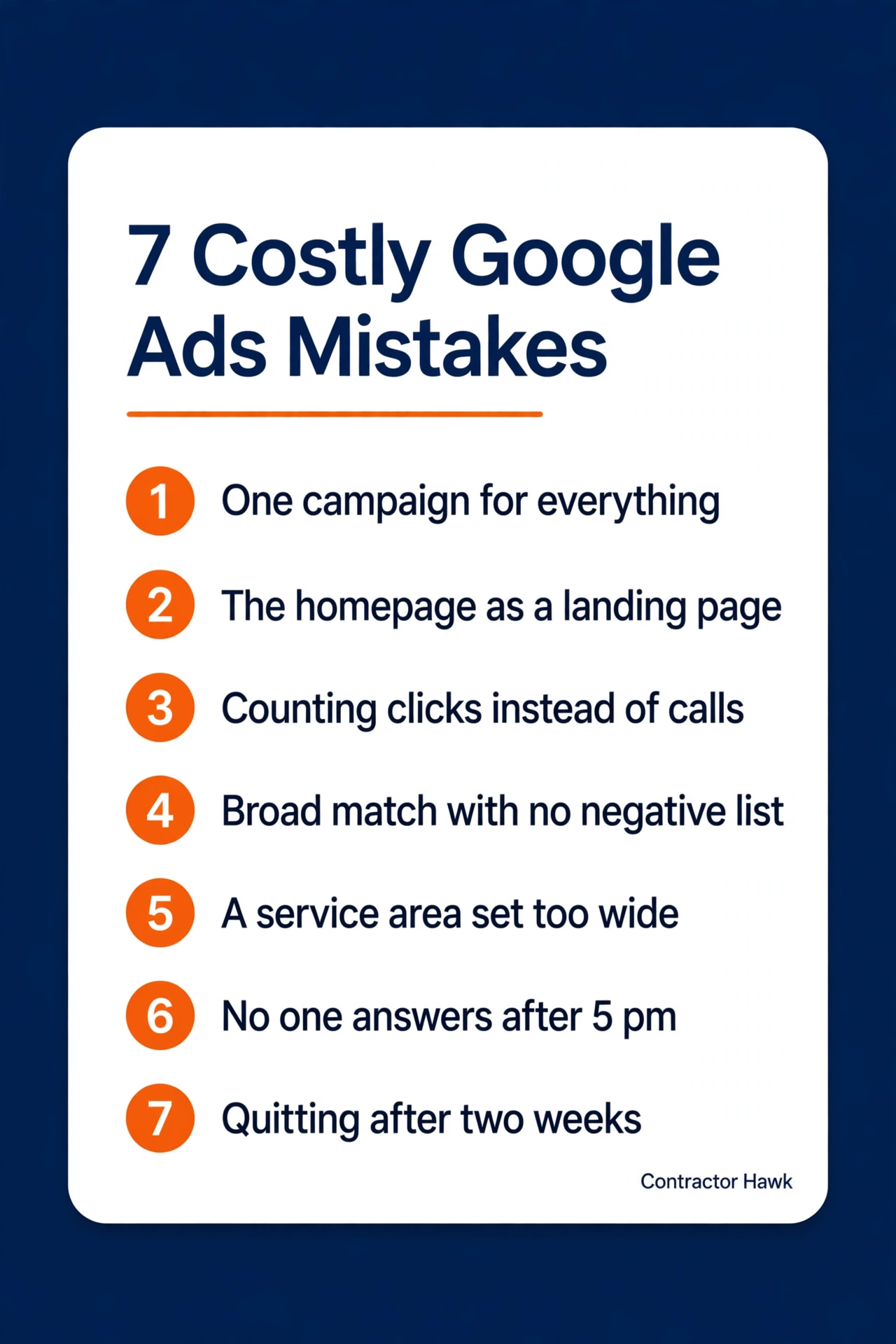
We see the same seven mistakes in account after account. Fix these before you raise your budget.
- One campaign for everything. Repair, install, and branded searches need their own budgets and bids. Lumped together, the worst keywords eat the best budget.
- The homepage as a landing page. A homepage makes visitors choose. A service page makes them call. Paid clicks deserve the page that converts.
- Counting clicks instead of calls. Clicks do not pay the bills. If calls are not tracked as conversions, every report lies to you.
- Broad match with no negative list. Google will happily spend your money on job seekers and DIYers. Negatives are the fence around your budget.
- A service area set too wide. Paying for clicks 60 miles out, where you never book, is a quiet way to double your costs.
- No one answers after 5 pm. Emergency searches peak at night. If the phone goes to voicemail, the lead calls your competitor.
- Quitting after two weeks. Early data is noisy. Pausing in week two means you never learn your real cost per lead.
Should You Run Google Ads, Local Services Ads, or Both?
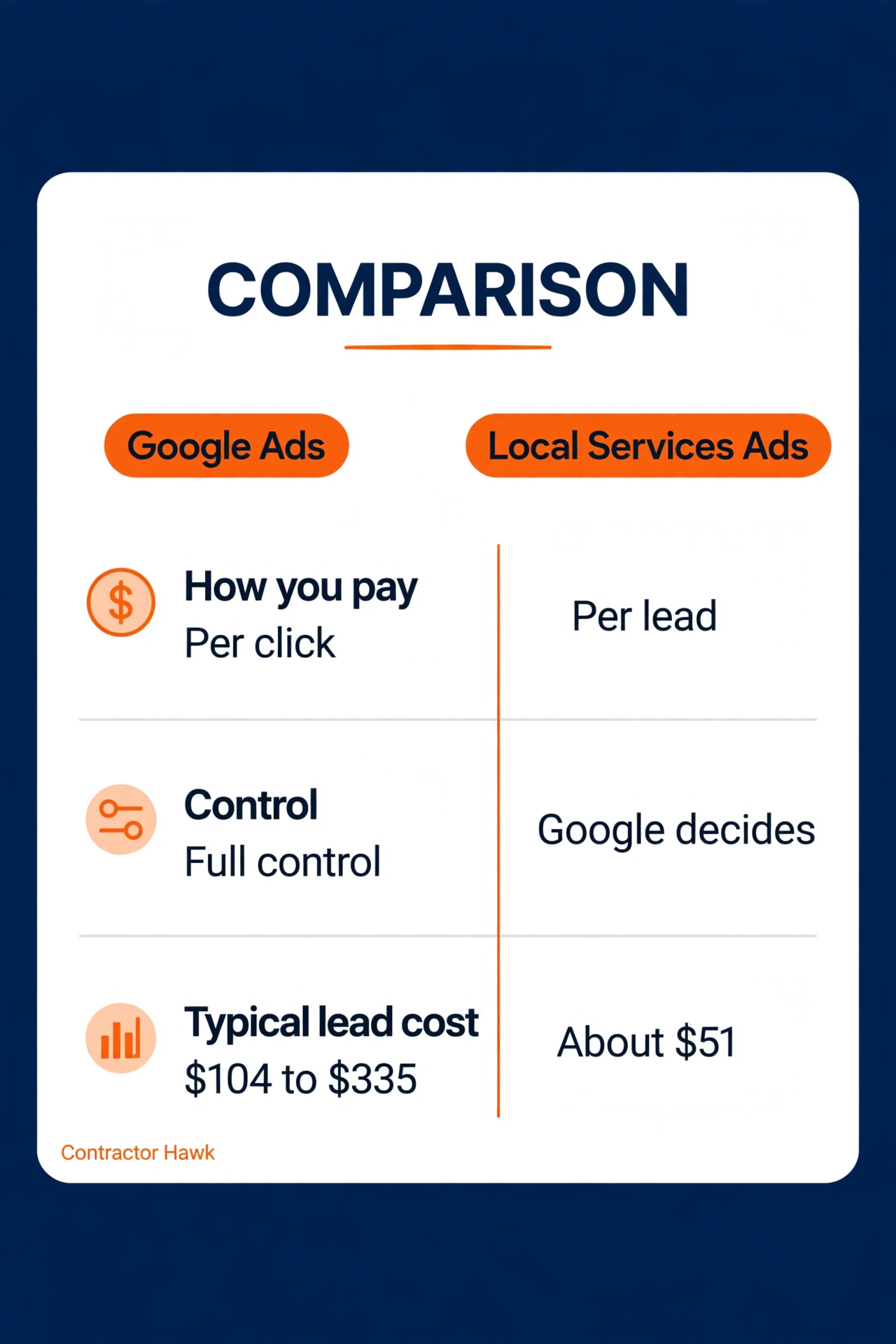
Local Services Ads put you at the top of the page with a Google Verified badge. You pay per lead instead of per click.
One 2026 benchmark put HVAC LSA leads near $51, well below search ads. The trade is control.
Google decides when your LSA shows, and you get fewer levers to pull.
Most shops run both. LSA catches high intent calls at a low cost. Search ads cover the keywords LSA misses and give you full control of budget and pages.
Read our Local Services Ads vs Google Ads comparison for the full breakdown. Then see whether Local Services Ads are worth it for HVAC in your market.
Some contractors also test Facebook ads for HVAC companies to fill slow weeks with maintenance offers. That is a different game, interruption instead of intent, and it works best once search is already humming.
Frequently Asked Questions
How much does HVAC Google Ads cost per lead?
Benchmarks for 2026 put most HVAC leads from $104 to $335. 99calls found a median from $190 to $335 across managed campaigns.
SearchLight Digital tracked $14.9M in spend and found a blended $104, with branded searches at $34 and non branded at $149. Your market and campaign setup decide where you land.
What is the difference between branded and non branded search campaigns?
Branded campaigns bid on your own company name. They are cheap, about $34 per lead in the SearchLight benchmark, because the searcher already knows you.
Non branded campaigns bid on terms like AC repair near me. They cost about $149 per lead but bring new customers who never heard of you.
How much should an HVAC company spend on Google Ads per month?
Say you want 10 leads a month. With leads from $104 to $335, plan roughly $1,040 to $3,350 in ad spend as a starting point.
Give any new campaign 60 to 90 days before you judge it. Cutting budget in week two starves the learning and tells you nothing.
Why do my Google Ads get clicks but no calls?
Poor landing pages cause most of it. A slow page, no click to call button, or a confusing layout kills calls.
Other causes: ads running when no one answers the phone, or broad keywords pulling wrong searches. Check your search terms report first.
Are Local Services Ads better than Google Ads for HVAC?
They do different jobs. Local Services Ads show with a Google Verified badge and you pay per lead, around $51 in one 2026 benchmark, with very high intent.
Google Ads cost more per lead but give you control over keywords, pages, and budgets. Most shops run both and let each cover what the other misses.
How long does it take for HVAC Google Ads to work?
You can get your first calls within days of launch. But give it 60 to 90 days to judge results.
Early weeks are for gathering data, blocking bad searches, and fixing the landing page. Contractors who pause after two weeks never learn what their real cost per lead would have been.
Google Ads work for HVAC when the structure is tight and the phones get answered. Start with tracking, separate your campaigns, and give it 60 days of honest data before you decide.
Want a second pair of eyes on your ads? Get a free audit. We will look at your campaigns, your landing pages, and your call tracking, and tell you what is wasting money.
Our promise: 10 new customers in 60 days, or your third month is free. Read the terms.