HVAC local SEO is the work that gets your company into the Google map results and local search results. It reaches homeowners nearby when they need heating or cooling help. It covers your Google Business Profile, your service pages, your listings across the web, your reviews, and the local links that point to your site.
Do it right and your phone rings without paying for every call. Skip it and you stay invisible while competitors take the jobs. This guide shows the five parts that matter, what to do first, and the mistakes that cost contractors calls.
Quick answer: what do I do, and is it worth my money?
- What to do: Fix your Google Business Profile and give each service its own page. Keep your name and phone the same on every listing, and ask every happy customer for a Google review.
- Is it worth it: Yes. Most of the work is free and costs time, not money. It is the reason some shops get calls from Google every day while others get none.
What this guide covers:
- What is HVAC local SEO?
- Map pack vs organic results
- Step one: your Google Business Profile
- Give each service its own page
- City pages only earn calls when they are real
- Keep your name and phone the same everywhere
- Reviews and local links build your prominence
- What to do first: your priority checklist
- Mistakes that hurt HVAC local SEO
- Frequently asked questions
What is HVAC local SEO?
HVAC local SEO means making your heating and cooling company easy for Google to show when someone near you searches for help. When a homeowner types “AC repair near me” or “furnace installation Houston”, Google decides which local companies to show and in what order.
Google says local results rest on three things: relevance, distance, and prominence. Relevance is how well your business matches the search. Distance is how close you are to the searcher.
Prominence is how well known and trusted your business looks, based on reviews, links, and complete information. You cannot move your shop, so focus on the two you control: relevance and prominence.
For the full picture of how this fits your whole marketing, read our complete HVAC SEO guide.
Map pack vs organic results
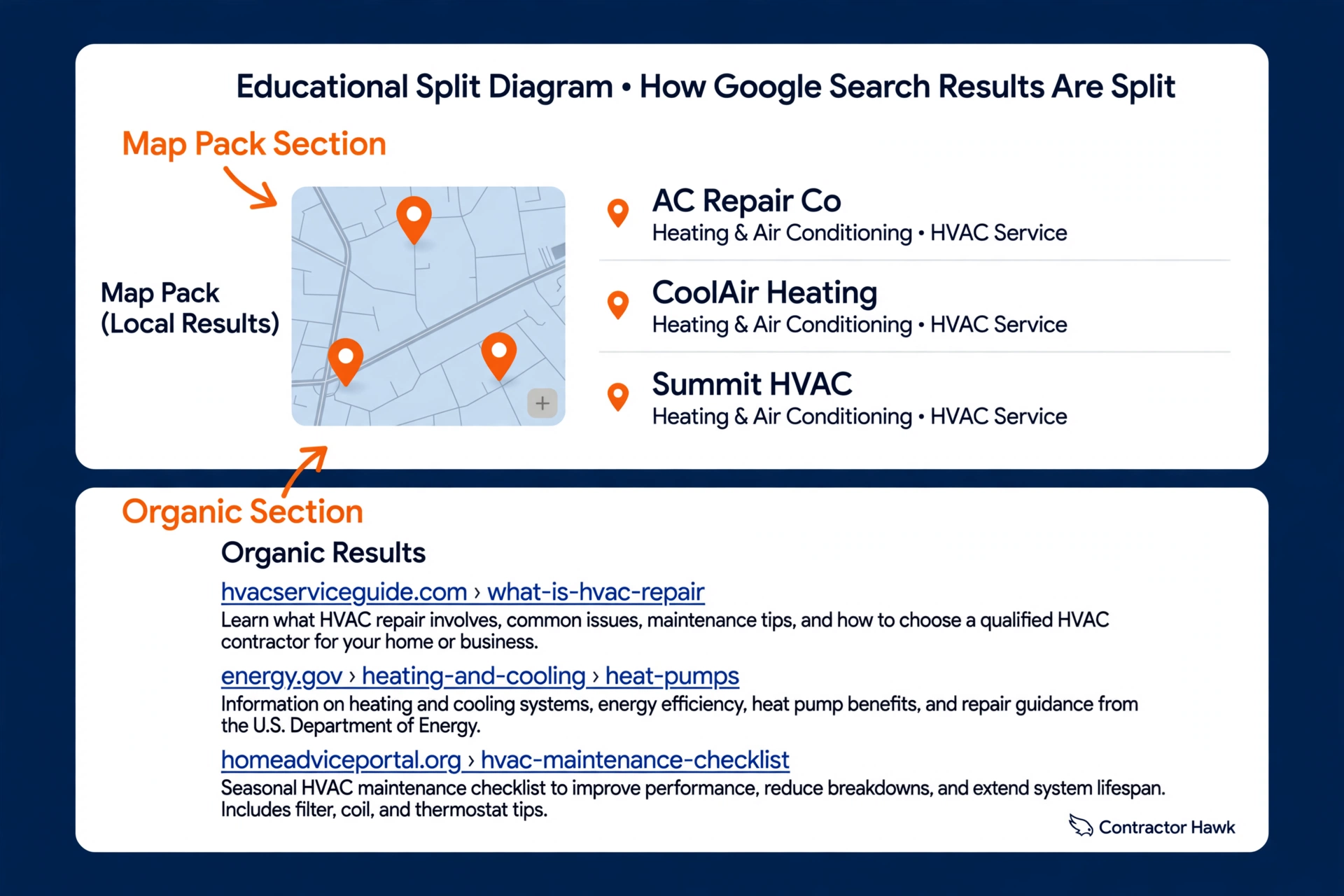
A Google search for a local service shows two kinds of results. The map pack is the map with three businesses under it. Below that come the organic results, the plain blue links to websites.
The map pack gets the calls from people in a hurry. A homeowner with no AC in July taps one of those three names.
The organic results catch people who scroll and compare. You want both, but they run on different fuel.
The map pack runs on your Google Business Profile, your reviews, and your distance. Organic results run on your website pages and the links that point to them.
Step one: your Google Business Profile
Your Google Business Profile is the free listing that feeds the map pack. Claim it, verify it, and fill in every field: name, category, service area, services, hours, and photos. A complete profile beats a half empty one every time.
We wrote a full setup guide for this, so this post will not repeat it. Follow our Google Business Profile setup guide for HVAC and come back here when the profile is done. Everything below builds on it.
Give each service its own page
One page per service is the strongest thing your website can do for local SEO. A page about AC repair, a page about furnace installation, a page about tune ups. Each page tells Google exactly what you do and lets a homeowner land on the exact help they need.
Each page should name the service in the headline and explain what the visit includes. List the towns you serve, show your phone number, and carry one clear call button.
Add a real photo from a job when you can. Keep the writing plain. A homeowner in a hot house does not read long paragraphs.
City pages only earn calls when they are real
A city page is a page about one town you serve. It can bring calls from that town when it holds real local information. That means a job you did there, photos from the area, and local questions with real answers.
If you copy one page and only swap the city name, Google may treat the set as doorway pages. Its spam policies call out this tactic by name.
Start with the three to five towns where you work most. Add a new page only when you have new, real content for that town. Our guide to service area pages walks through the full method, including the swap city test that keeps you safe.
Keep your name and phone the same everywhere
Citations are the listings of your business on other sites: Yelp, Angi, the BBB, Facebook, and industry directories. Google cross checks them to confirm your business is real.
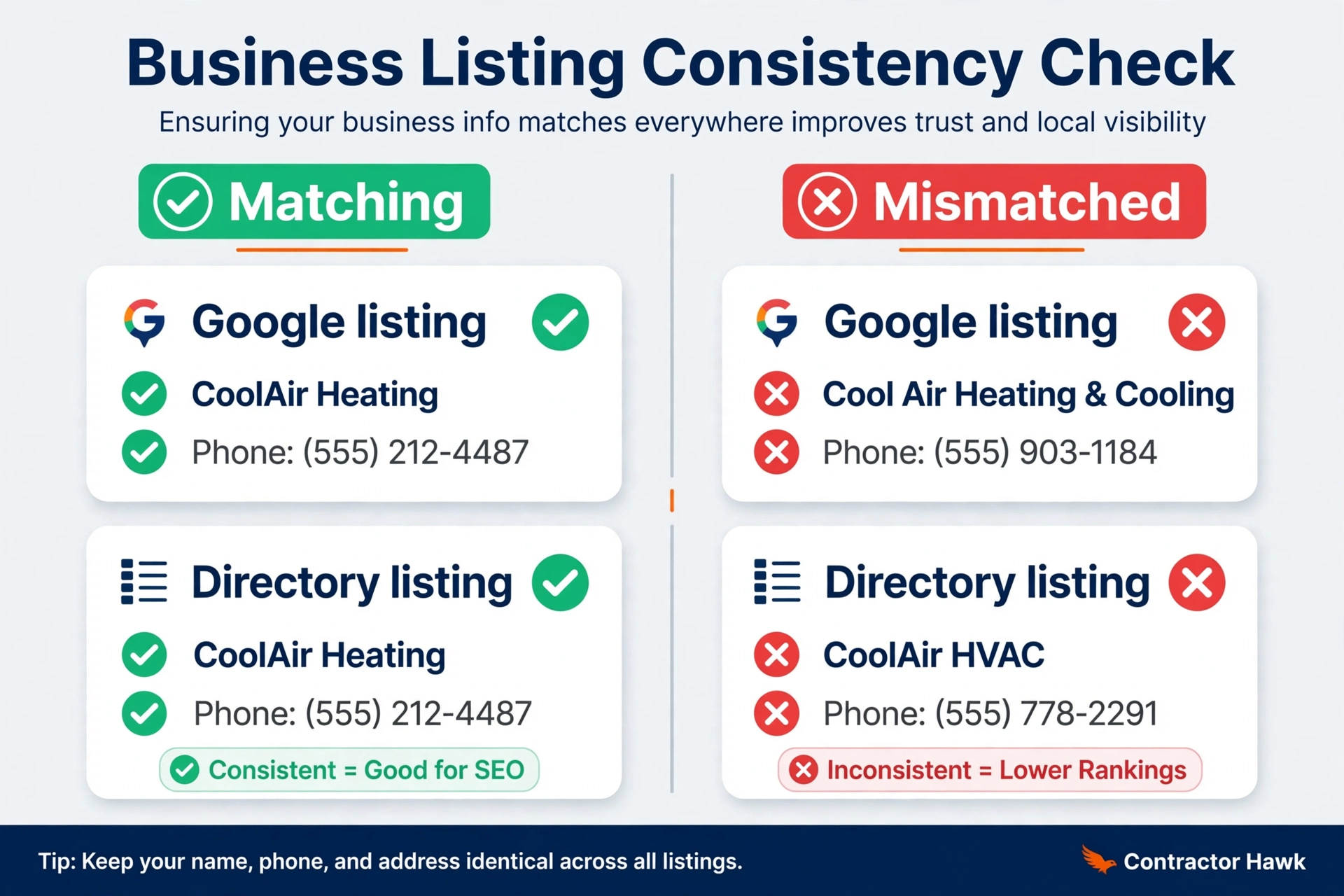
When your name, address, and phone match everywhere, Google trusts you more. When they differ, Google trusts you less.
Pick one exact version of your business name and one main phone number. Use them on your website, your profile, and every directory.
Fix old listings that show a retired number or a slightly different name. This is quiet work, but it removes doubt about your business.
We will go deeper on which directories matter in our upcoming guide to HVAC citations and directories.
Reviews and local links build your prominence
Prominence is how well known your business looks to Google. Two things build it: reviews and links from other websites.
Ask every happy customer for a Google review. Text them a direct link while you are still in the driveway. Reply to every review, good or bad.
A steady flow of honest reviews beats a burst of old ones. Google says it plainly in its guide to improving local ranking: more reviews and positive ratings can help your local ranking.
Local links come from real community ties. Think of a chamber of commerce listing or a youth team sponsorship. A supplier who lists you as a dealer counts too, as does a local news story about your company.
One honest local link beats ten bought directory links. Never pay for links. Google treats paid links as spam, and the damage lasts longer than any short gain.
What to do first: your priority checklist
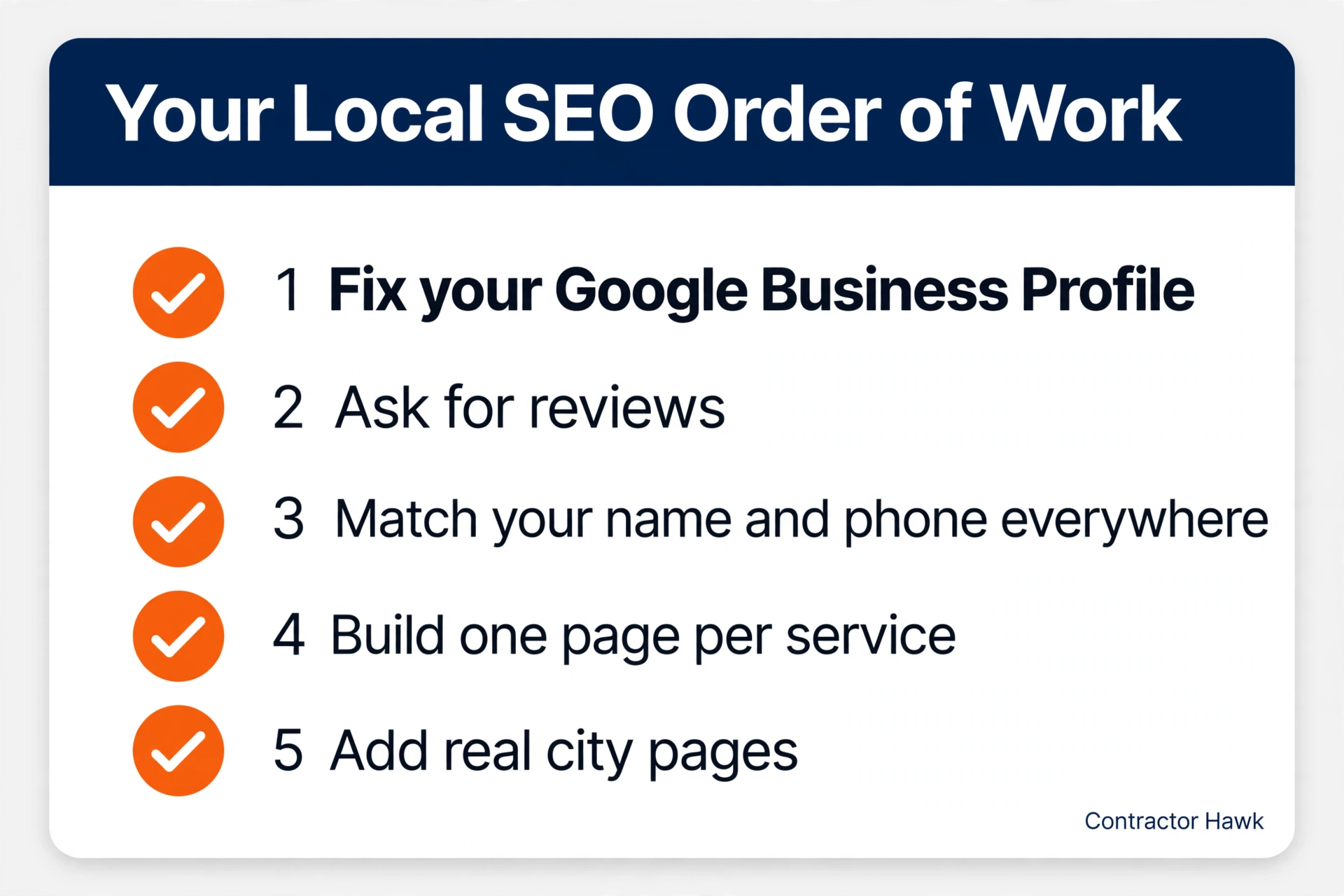
Do these in order. Each one makes the next one work better.
| Step | What to do | Why it comes first |
|---|---|---|
| 1 | Claim and complete your Google Business Profile | It feeds the map pack, where urgent calls start |
| 2 | Ask every customer for a Google review and reply to each one | Reviews build prominence and trust fast |
| 3 | Match your name and phone on every listing | Removes doubt about your business |
| 4 | Build one page per main service | Gives Google and homeowners exact answers |
| 5 | Add city pages only where you have real local proof | Wins nearby towns without spam risk |
Mistakes that hurt HVAC local SEO
These are the mistakes we see most in audits. Each one is easy to avoid once you know it.
- Stuffing keywords into the business name. “AC Repair Cheap Houston” is not your business name. Google suspends listings for this. Use your real name only.
- Copying city pages with only the town swapped. Google calls this doorway abuse. One real page beats ten thin ones.
- Letting your phone number drift across listings. An old number on Yelp and a new one on your site tells Google your data cannot be trusted.
- Buying links or directory packages. Paid links violate Google’s spam policies. Earn local links through real community ties instead.
- Ignoring reviews. Unanswered reviews, especially bad ones, tell homeowners you do not care. Reply to every one.
- Expecting results in a week. Local SEO builds over months. The shops that win are the ones that keep at it.
Frequently asked questions
How long does local SEO take for an HVAC company?
Expect months, not days. The profile and review work can move the map pack in weeks, but lasting organic rankings build over several months of steady effort. The shops that win are the ones that keep at it quarter after quarter.
What is the difference between local SEO and regular SEO?
Local SEO targets the map pack and “near me” searches in your service area. Regular SEO targets broader searches that are not tied to a place. An HVAC company needs local SEO first, because almost every customer searches with a location in mind.
Do I need a separate page for every city I serve?
No. Build a page only for towns where you have real local proof, like jobs, photos, or reviews from that area.
List the rest in your service area settings and on your main service pages. Thin copied pages can hurt you.
How many Google reviews do I need to rank?
There is no magic number. A steady flow of honest recent reviews beats a big old pile.
Ask every happy customer, reply to each review, and keep the stream going. Recency and replies matter as much as the count.
Can I do HVAC local SEO myself?
Yes for the basics. You can claim your profile, ask for reviews, and fix your listings yourself in a few focused evenings.
Website pages and local link building take more skill. A free audit shows which parts you can handle and which need help.
Local SEO is the highest value free marketing an HVAC shop can do. Start with your profile and reviews this week, then work the checklist in order.
Want a second pair of eyes? Get a free audit and we will tell you what is costing you calls.
Our promise: 10 new customers in 60 days, or your third month is free. See the terms.
For help with the whole plan, a marketing partner that works only with HVAC contractors can run your local SEO for you.